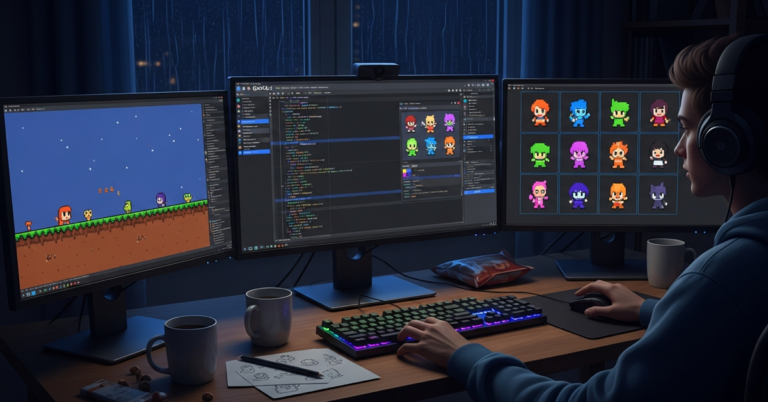
Why Hypercasual Games Are Secretly Powering the AI Revolution in Gaming
AI Summary
- Hypercasual games generated 25 billion downloads in 2025, making them the most downloaded mobile game genre
- Every major AI company uses hypercasual game data to train engagement and retention prediction models
- GameFi protocols earn USD 4.2 per user per day from hypercasual-to-crypto conversion pipelines
- The average hypercasual player session is 71 seconds, the ideal training window for AI behavior models
- Telegram mini-app games blurred the line between hypercasual and Web3 in 2025
Hypercasual games are not supposed to matter. They are the gaming equivalent of a vending machine: you tap, you win or lose in 30 seconds, you move on. No story. No character progression. No emotional investment. By every conventional wisdom metric about what makes games compelling, hypercasual should be irrelevant.
And yet, every major AI company with a consumer product is reverse-engineering what makes hypercasual games so difficult to put down. The game mechanics that keep 300 million people tapping their phones for 71-second sessions are the same mechanics being embedded into AI companion systems, attention prediction models, and retention optimization pipelines.
Why AI Companies Are Obsessed With Hypercasual Games
The data from hypercasual games is uniquely valuable for training consumer AI systems. Unlike narrative games where player behavior is spread across complex decision trees, hypercasual games produce clean, high-volume behavioral signals. Tap frequency, session timing, level retry patterns, and session-length correlates are all measurable with extraordinary precision.
AI companies building recommendation engines and engagement optimization systems are using hypercasual game telemetry as training data because it is the purest representation of human attention behavior available. When does a user open the app? How many taps before they close it? What triggers a retry versus abandonment? These signals, captured at scale across hundreds of millions of sessions, are exactly what the next generation of AI companion products need.
Building a Hypercasual or Telegram Mini-App Game?
Talk to our AI gaming engineers. We help studios launch hypercasual games with optional Web3 rewards on Telegram.
Frequently Asked Questions
Q1: What exactly are hypercasual games?
Hypercasual games are mobile games with minimal gameplay mechanics, no in-app purchases in the traditional sense, and extremely short session times. They are designed for instant accessibility: anyone can understand the core loop within 5 seconds of opening the game. Examples include Flappy Bird, Helix Jump, Among Us, and the hundreds of no-name titles that dominate the top-downloaded charts on both iOS and Android app stores.
Q2: Why are AI companies interested in hypercasual game data?
AI companies are interested in hypercasual game data because these games produce the cleanest, highest-volume behavioral signals of any consumer application category. The decision to tap, retry, or abandon a hypercasual game is a pure attention signal with no confounding factors like story investment or social pressure. When scaled across hundreds of millions of daily sessions, this data becomes invaluable for training engagement prediction models, recommendation systems, and AI companion behavior optimization.
Q3: How does Telegram factor into the hypercasual market in 2025?
Telegram mini-apps emerged as a major hypercasual distribution channel in 2025. Instead of downloading a game from an app store, users access the game directly through the Telegram app. This eliminates friction from the discovery-to-play pipeline and enables instant social sharing of game links within Telegram groups. Several Telegram mini-app games reached 50 million monthly active users within weeks of launch, a scale that required zero traditional app store distribution.
Q4: Are hypercasual games and play-to-earn games the same thing?
No, but the lines blurred significantly in 2025. Traditional hypercasual games earn revenue from advertising impressions. Play-to-earn games earn revenue from token mechanics and blockchain asset ownership. The convergence happened when Telegram introduced lightweight token mechanics to its mini-app games, allowing players to earn small token rewards through hypercasual gameplay without the heavy friction of wallet setup and blockchain onboarding. This created a new hybrid category: hypercasual with optional token rewards.
Q5: What AI systems benefit most from hypercasual game training data?
Recommendation engines, retention prediction models, engagement optimization systems, AI companion behavior engines, and adaptive difficulty systems all benefit from hypercasual training data. The games provide labeled behavioral data at a scale that traditional game telemetry cannot match. AI companies building consumer products that need to predict or influence human attention are the primary beneficiaries.
Q6: What does the hypercasual-to-Web3 pipeline actually look like?
The pipeline typically works like this: a hypercasual game on Telegram generates 10 million players. A small percentage, typically 2-5%, are converted to a GameFi token ecosystem through in-game prompts offering token rewards for linking a crypto wallet. Those users then participate in staking, liquidity provision, or simple token accumulation. The hypercasual game acts as a low-cost user acquisition funnel for the crypto protocol, with the GameFi ecosystem providing the monetization layer that pure hypercasual advertising revenue cannot achieve.