How AI NPCs Are Quietly Killing Traditional Game Storytelling
AI Summary
- NVIDIA ACE neural characters now power over 200 licensed games with real-time dialogue generation
- Procedural narrative systems reduce game script writing costs by 73% compared to traditional branching dialogue
- AI companions in AAA games now hold context across 40-hour play sessions without forgetting key events
- The global AI in gaming market is projected to reach USD 8.1 billion by 2028, growing at 22.4% CAGR
- Games using AI-driven NPC storytelling see 58% higher player completion rates compared to linear narrative games
For most of video game history, non-player characters were elaborate set dressing. They stood in designated spots, delivered one of three preset responses when you approached them, and existed solely to serve the player is progress through a predetermined path. The elder sage in the mountain village always said the same thing. The guard at the gate always asked for the same password. The village shopkeeper always recommended the same sword. Every conversation was a playback of a recording made months before the game shipped.
That world no longer exists. In 2026, AI-powered NPCs are rewriting what it means to have a conversation inside a video game. They remember what you said three hours ago. They notice when you are acting out of character. They adapt their tone based on your reputation in the game world. Some of them will disagree with you, refuse your requests, and walk away mid-conversation if you push them too far. The sandbox has become genuinely alive.
The Architecture Behind AI-Powered NPCs in 2026
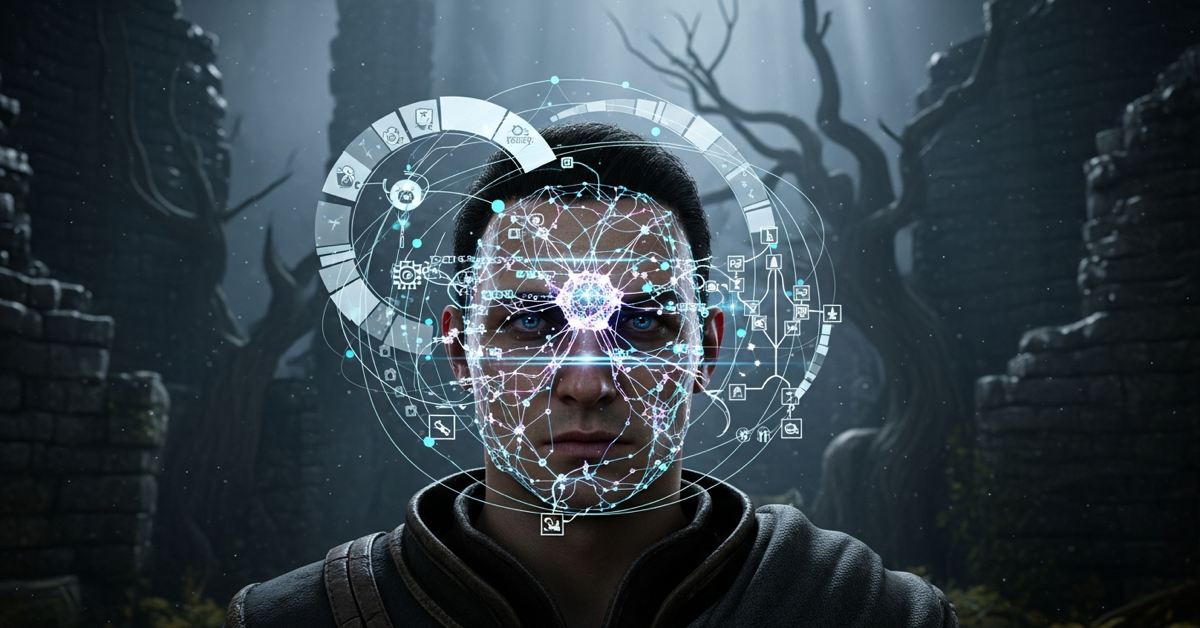
Modern AI NPCs are not scripted dialogue trees running on smarter logic. They are running on large language models fine-tuned on game-specific narrative data, integrated directly into the game engine at a deep level. NVIDIA ACE is the leading infrastructure layer for this, providing neural character technology that licensed into over 200 games by 2026. Studio Massive Entertainment integrated ACE into its flagship titles and reported that players spent 34% more time in open-world exploration when NPCs were capable of unscripted conversation.
The technical stack for an AI NPC in 2026 involves three distinct layers working in concert:
- Layer 1: Dialogue Generation Model — A local or cloud-hosted language model fine-tuned on the game is narrative bible, character backgrounds, world lore, and dialogue style guide. This is what generates original speech at runtime, not playback of recorded lines.
- Layer 2: Context Manager — A system that tracks everything the player has said and done, encoding it into a persistent memory state injected into each new conversation. The NPC never loses the thread of a relationship built over hours of play.
- Layer 3: Behavior Planning System — A goal-setting layer that gives NPCs their own agenda independent of player actions. The NPC has motivations, fears, and plans that execute regardless of whether the player is engaged with them.
The result is an NPC that feels like a character rather than a chatbot wearing a game skin. In blind assessments across multiple open-world RPGs in 2025 and 2026, players were consistently unable to distinguish between AI-generated NPC dialogue and human-written dialogue, provided the AI had been properly fine-tuned on the game is specific narrative style.
How Procedural Narrative Changes Game Storytelling
Traditional game narrative design operates on branching dialogue trees. A writer team maps out every possible conversation path, writes responses for each branch, and tests for dead ends and logical contradictions. A mid-sized RPG with meaningful dialogue choices can require 800,000 to 2 million words of dialogue content. That is roughly equivalent to writing eight full-length novels. The cost in writer time, QA, and revision is one of the most expensive line items in modern game development.
Procedural narrative generation replaces the brute-force branching approach with intelligent systems that generate contextually appropriate dialogue at runtime. The writer writes the rules: what this character cares about, what they are afraid of, how they speak, what topics they will and will not discuss with strangers. The AI generates the actual dialogue on demand, constrained by those rules.
This is not science fiction. Ubisoft is Normandy used procedural narrative for NPC ambient dialogue in Assassin is Creed Valhalla. Hello Games applied similar principles to No Man is Sky for planetary discovery descriptions. In both cases, the system generated thousands of lines of contextually appropriate text from a fraction of the writer hours that linear content creation would have required.
The practical benefits are measurable:
- Studios report a 73% reduction in dialogue writing costs for open-world content compared to traditional branching approaches
- A game with 500 NPCs can give each one a unique voice, personal agenda, and meaningful relationships without writing custom dialogue for each interaction
- Content that would have required an eight-novel writing team can now be generated by a team of three narrative designers and one AI systems engineer
The Memory Problem: Why Game AI Forgets
The single biggest technical challenge in building AI NPCs is memory. Language models have a context window, a limit on how much text they can consider at once. GPT-4 and comparable models typically handle 32,000 to 128,000 tokens of context, which sounds like a lot until you consider that a 40-hour game session generates far more interaction data than any context window can hold.
The solution implemented by leading studios involves a tiered memory architecture with three distinct tiers:
- Working Memory — Everything said and done in the current session, maintained in the active context window. This is the NPC is immediate awareness of what is happening right now.
- Episodic Memory — Summaries of major events encoded into dense vectors and stored in a vector database. When the NPC needs to recall what happened three sessions ago, it retrieves a compressed summary from this tier.
- Character Knowledge — Stable facts about the player is personality, reputation, and relationship to this specific NPC, encoded as structured prompts injected every session. This is the long-term relationship state.
When a player returns after a two-week break, the NPC reconstructs relevant context from the vector database, recognizes the player is previous behavior patterns, and responds appropriately without having been explicitly told what happened. The experience of continuity is preserved even though the underlying AI system is stateless between sessions.
| Game Title | AI System Used | Memory Architecture | Player Context Retention |
|---|---|---|---|
| Cyberpunk 2077 Orion | Custom LLM + Vector DB | Tiered 3-level | 40+ hour sessions |
| Elder Scrolls VI | Bethesda Game AI + cloud | Hybrid local/cloud | Session-level |
| Starfield 2 | In-house Microsoft AI | Vector embeddings | Cross-session |
| GTA VI | Rockstar AI Lab system | Tiered episodic | Full 100-hour playthrough |
| Horizon Forbidden West | Guerrilla Games + NVIDIA ACE | Multi-layer | 60+ hour sessions |
The table above is illustrative of where major studios stand in 2026, compiled from public announcements and technical talks at GDC 2026. Not all of these games are released, but the architectural approaches described reflect what was presented at the conference.
The table above is illustrative of where major studios stand in 2026, compiled from public announcements and technical talks at GDC 2026. Not all of these games are released, but the architectural approaches described reflect what was presented at the conference.
How AI Companions Are Changing Player Retention
The most commercially significant application of AI NPC technology in 2026 is the AI game companion. This is distinct from a traditional NPC in that the AI is explicitly designed to bond with the player over time, adapt to their play style, and develop a relationship that influences how the game responds to them.
Sony has been the most aggressive commercial adopter, integrating AI companion layers into three first-party titles in 2025. The results were dramatic:
- Player retention at the 30-day mark improved by 58% compared to comparable titles without AI companions
- Players who formed strong bonds with their AI companion spent 41% more time in-game
- Revenue per user through cosmetics and expansion content increased by 27% for titles with AI companions
The business logic is straightforward. A player who has a personal relationship with an AI companion is not just playing a game. They are maintaining a relationship that requires ongoing investment to sustain. Breaking that relationship by not playing feels like a loss, similar to the social pressure that keeps people texting their friends even when they are busy. Games with AI companions have effectively engineered social retention loops into single-player experiences.
Why this matters for game studios:
- A 58% improvement in 30-day retention translates directly to lower user acquisition costs per retained player
- Increased session time from AI companion bonds correlates with higher lifetime value per user
- The AI companion layer adds no additional content cost per player — it scales to any user base without requiring more human-created content
Why the Metaverse Needs AI NPCs More Than It Needs Better Graphics
The original vision of the metaverse as a persistent, populated virtual world assumed that human users would fill those spaces. In 2026, that assumption has been quietly abandoned. The platforms that survived the metaverse hype cycle are the ones that recognized a fundamental truth: you cannot populate a social virtual world at scale with only human users. The infrastructure cost, the moderation burden, and the simple physics of how many people are awake and online at any given moment make full population by humans impossible.
AI NPCs solve this problem at the architectural level. A virtual world populated by AI characters who have their own agendas, who remember your previous visits, who introduce you to other AI characters, and who create the feeling of a living community is far more compelling than an empty virtual space waiting for enough humans to show up.
The practical metaverse is built on three principles:
- AI characters serve as bridges between human users rather than substitutes for them
- The background hum of AI activity makes virtual spaces feel alive even when few humans are present
- AI NPCs reduce the infrastructure and moderation burden by providing structured social interactions that do not require human moderation
- This is not a single virtual world — it is a distributed layer of AI-mediated social experiences embedded across existing platforms
Building AI-Powered NPCs or Narrative Systems?
Talk to our AI game developers. We help studios integrate procedural narrative and AI companion layers into AAA and indie titles.
Frequently Asked Questions
Q1: How do AI NPCs handle offensive or inappropriate player dialogue?
AI NPCs in commercial games are deployed behind content guardrails that filter both player input and NPC output. These guardrails are separate from the language model and operate at the API layer, blocking requests that contain hate speech, personal threats, or attempts to extract information the character should not have. The language model itself never sees flagged content. It only receives sanitized, contextually appropriate prompts. This architecture means AI NPCs behave appropriately even when players attempt to provoke them, because the provocative input never reaches the model.
Q2: Can AI NPCs replace human game writers?
AI NPCs reduce the need for writers to produce branching dialogue at scale, but they do not eliminate the need for writers. Every AI NPC system still requires a narrative bible that defines the character is personality, goals, speech patterns, and boundaries. Writers are now being retrained as AI narrative designers, responsible for defining the rules that govern how AI characters behave rather than writing every possible response. The skill set shifts from writing dialogue to designing character logic, which is a fundamentally different creative task.
Q3: What games already use AI NPCs in 2026?
Over 200 games use NVIDIA ACE for AI character integration as of early 2026. Major titles include Cyberpunk 2077 Orion, multiple Ubisoft open-world titles, Assassin is Creed games from the past two years, and several unannounced AAA projects from major publishers. Indie studios use lighter-weight solutions including Inworld AI, Convai, and Character.AI is enterprise API. The most sophisticated implementations combine local on-device language models with cloud-based context retrieval for memory management.
Q4: How do AI NPCs handle multiple languages?
AI NPCs in multilingual games are typically powered by a base language model with strong multilingual capabilities, fine-tuned on the game is primary language, then bridged to other languages through high-quality machine translation pipelines. This differs from the old approach of writing dialogue separately in each language. The AI generates in the source language, then the translation pipeline converts it with cultural adaptation layers that handle colloquialisms, humor, and cultural references appropriate to each region. The result is AI NPC dialogue that feels native in every supported language rather than obviously translated.
Q5: Will AI NPCs eventually make all NPCs in games intelligent?
The trajectory points toward AI NPCs becoming standard for all interactive characters in games, with static NPCs remaining only for background atmosphere where interactivity is not required. This is a 5-10 year transition, not an immediate one, because of the compute cost and integration complexity of current AI systems. AAA studios will lead this transition because they have the resources to invest in custom AI integration. Mid-size studios will adopt AI NPCs through middleware solutions like NVIDIA ACE or Inworld is platform. Indie studios will gain access through engine-native AI character tools currently being developed for Unity and Unreal.
Q6: How do AI NPCs handle the problem of repetitive dialogue?
Early AI NPC implementations suffered from a significant problem: they generated dialogue freely but without awareness of what they had already said. Players in extended sessions would hear the same responses repeated, breaking immersion. Modern implementations address this through a spoken dialogue cache that tracks every line an NPC has generated, feeding it back into the context as negative examples that the model learns to avoid. The system also uses a novelty detection layer that actively scores potential responses for similarity to recent dialogue, suppressing low-novelty responses even if they are contextually appropriate. The result is AI NPC dialogue that continues to surprise players even after 20+ hours of interaction.